WORK · 01 / SOLD · MADE AGAIN ON REQUEST
Faturan on calligraphy
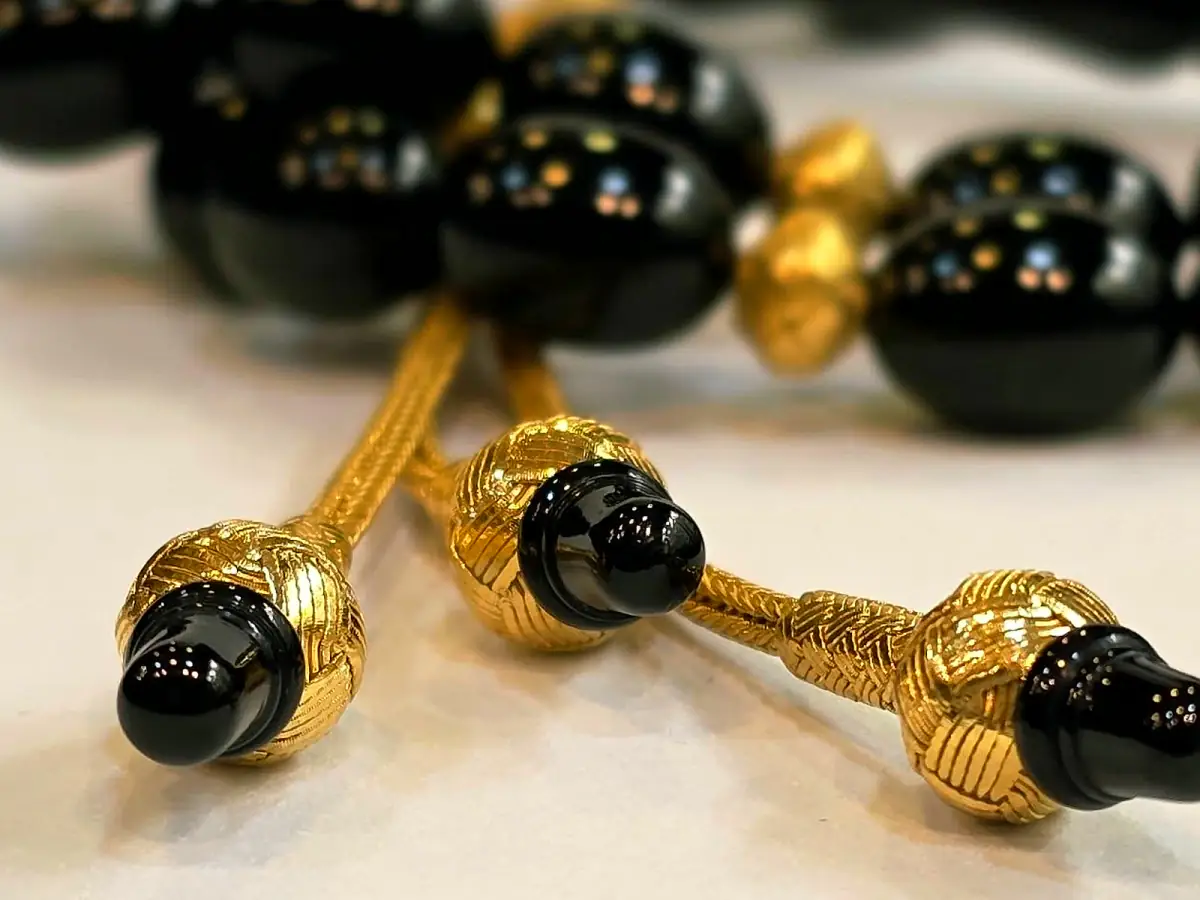
Dark faturan · 24-carat kazaz tassel, four medallions
On an Ottoman manuscript
 Ulvi İskender
In the handsof its master,gold speaks its own tongue.
A finely drawn wire takes shape knot by knot between the fingers. In the hands of Ulvi İskender, kazaz is not merely a craft; it is a form of expression built from proportion, patience and memory. Each work is conceived on its own, braided by hand and completed with a character of its own.
24-carat gold · hand-braided · Trabzon
Gold wire · braided by hand · Trabzon
WORK · 01 / SOLD · MADE AGAIN ON REQUEST
Dark faturan · 24-carat kazaz tassel, four medallions
On an Ottoman manuscript
WORK · 02 / SOLD · MADE AGAIN ON REQUEST
Milk-amber beads · gold cord, single knot, coral tip
Plain cord, single piece
WORK · 03 / SOLD · MADE AGAIN ON REQUEST
Green agate beads · gold kazaz head bead, triple tassel
The colour of the stone, the light of the wire
WORK · 04 / SOLD · MADE AGAIN ON REQUEST
Red faturan · gold cord, coral tip
On a calligraphy sketch
WORK · 05 / SOLD · MADE AGAIN ON REQUEST
White beads · gold kazaz tassel
Studio, black ground
WORK · 06 / SOLD · MADE AGAIN ON REQUEST
Coral drop beads · gold kazaz, multiple tassels
Black ground
İSKENDER ATELIER
Kazaz is a discipline that begins with gold in its finest state. The wire is drawn, finds its direction, becomes a knot; as the knots multiply, the form builds its own inner architecture. Here the master's hand does not merely shape the material; it gives it rhythm, balance and identity.
Looking at a kazaz work, what you see is gold. What makes it a work is the time you cannot see.
01 · PRINCIPAL WORK
The deep tone of coral meets the fine memory of gold.
The rhythm of ninety-nine coral beads is completed by a hand-braided kazaz tassel. Gold here is not an ornament added afterwards; it is the element that sets the work's measure, its flow and its final movement.
SELECTED WORKS
Kazaz works selected from different periods, materials and pursuits. Forms from the same hand that never repeat one another.
01 · KAZAZ · 40 WORKS
The language of kazaz is built on repetition; but repetition is not sameness. The thickness of the wire, the weight of the bead, the fall of the tassel, the density of the knot and the proportion of the work are reconsidered every time. Two works may share the same technique and yet never the same character.
Touch a work — all its images open.
02 · JEWELLERY · 4 WORKS
From tassel to necklace, from earring to bracelet, the traditional kazaz technique gains a new way of being worn. The knot keeps the same discipline; but its relationship with the body redefines the proportion and movement of the work.
03 · CONCEPTION · 8 DRAWINGS
What the hand will make first passes the test of eye and mind. Proportions are set; the course of the knot, the position of the stone, the movement of the wire and the reply the parts give one another are sought on the line.
The drawing is not merely a sketch of the finished work. It is thought, built before visible form.
04 · SUBSTANCE
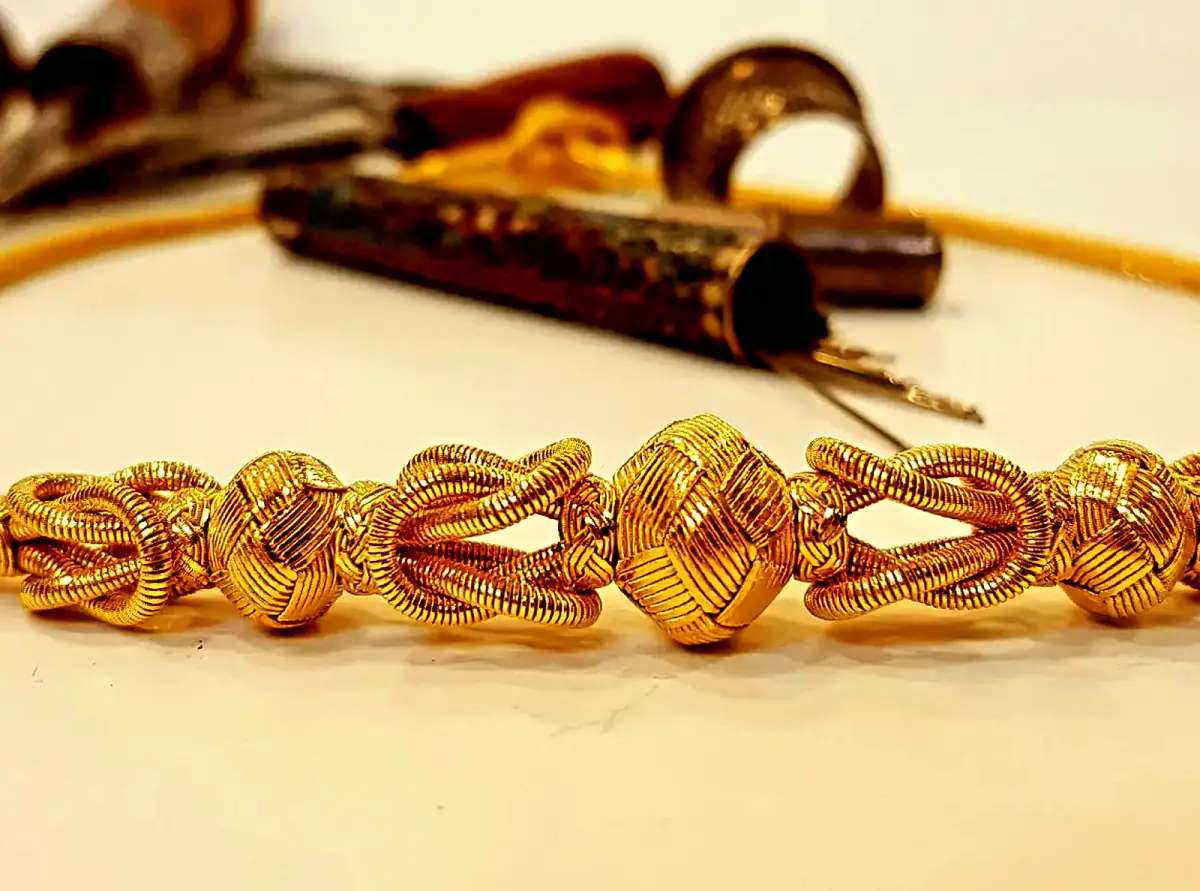
The fineness of kazaz has no need to hide the truth of its material. The İskender Atelier works with 24-carat gold and silver wire; instead of the passing shine of plating, the metal's own character is preserved.
As the wire grows finer, gold does not grow lighter; it only reaches another language. When the braid is complete, what remains in the hand is the form the master gave as much as the weight of the metal.
— İSKENDER ATELIER
FROM THE ARCHIVE
Every piece that leaves the atelier carries a trace of its period. Material changes, proportion changes, the search changes; what remains is the quiet continuity of forms that passed through the master's hands.
THE PRACTICE OF MASTERY
In kazaz, the way to the result is as much part of the work as the result itself. No knot is independent of the next; every movement carries the measure of the one before and prepares a place for the one after.
01
The work is built in thought before the gold is touched. Proportion, movement, the course of the knot and the reply of material to material are sought on the line.
02
24-carat gold is drawn until it reaches the fineness kazaz demands. At this stage the wire does not merely thin; it is prepared for the tension and movement the work will carry.
03
Between the fingers, the wire begins to build its own architecture. Each knot determines the next; the repeated movement turns, with patience, into form, and form into character.
04
The tassel gathers at the head bead, the beads find their place within their rhythm, the last knot closes. At this moment the work is not merely finished; it becomes ready to leave its master's hands.
05 · İSKENDER ATELIER · THE MASTER AT THE BENCH
The time of a kazaz work is not measured by the clock. The hand knows when the wire will yield, when the knot will find its place, when a proportion will feel right.
At the İskender Atelier in Trabzon, works are completed not as repetitions of a series but as singular pieces seeking their own measure. The same technique may be applied again; the same work is never born again.
Mastery is not repeating what the hand knows; it is knowing, every time, where to stop.
+90 533 666 31 91WITH MASTERS
Some works are born not of a single material but of the meeting of two traditions of mastery. The bead carries the knowledge of one hand, the kazaz the memory of another. Their meeting point is the work itself.
MASTER · 01
The trace of two hands in one work. Each keeps its own mastery; the whole is born not of repeating one another but of making room for one another.
MASTER · 02
A kazaz tassel designed around the weight and character of 15/16 mm Ottoman amber beads. The proportion between bead and braid sets the balance of the work.
MASTER · 03
A kazaz tassel shaped to the character of a master-made glazed kuka strand. The braid completes the line of the work without standing in front of it.
A form that begins in the master's hands enters another time in the life of its owner. Part of the continuity of kazaz lies here: hands change, the work remains; the meaning goes on living.


1 / 1